Big News this week for The Reluctant Eater

Monday, October 27, 2008

Several great things are happening this week for The Reluctant Eater. Here is a quick summary, but read on for more details.

  • I will be reporting from Naturally Boulder Days this Wednesday & Thursday
  • I am giving a presentation on food headlines since 1935 at Ignite Boulder this Wednesday
  • The Reluctant Eater has become a Featured Publisher for FoodBuzz!

The Reluctant Eater Reporting from Naturally Boulder Days

Naturally Boulder Days, held October 29th & 30th here in Boulder, CO, is the event for local food & natural products entrepreneurs. There are information sessions, lunches with a mentor, tours of local companies, new ideas & product pitches, and plenty of networking opportunities.


I will update this site throughout the event with any kind of information you might find useful. Keep in mind, although most of the companies mentioned will be local to the Boulder area, there will be plenty of the content I post will appeal to a wider audience, for example the break out session covering emerging trends in the industry. Check back here often on Wednesday, Thursday, & Friday.

The Reluctant Eater Presenting at Ignite Boulder

Ignite is a worldwide movement of people gathering together to share information and ideas on a wide variety of topics. However, it's not that straightforward. Each presenter gets only 20 slides, which automatically advance every 15 seconds. It's harder than you think!

Presentation ideas need to be submitted and approved by a panel, and mine was accepted this weekend! The topic, based on these two posts, is titled:
A Whirlwind Tour Through Eight Decades of Food Advice: Why You Shouldn't Entrust Your Eating Habits to the Media, Government, or Food Science
This will be a great event, so if you live in the area, come out and show your support, learn a few things, and please introduce yourself! Tickets are free, but as of this writing there are only 41 left. Click here to get yours. If you miss it, next week I will post the video of my presentation, along with my notes and the powerpoint slides.

The Reluctant Eater: A Featured Foodbuzz Publisher

You may notice the Featured Publisher badge down in the lower right hand corner of each page. There may be a few more layout changes to accommodate another Foodbuzz banner. Fear not intrepid reader, nothing else will change (other than some increased traffic to this site)! Foodbuzz is a great site that collects and ranks the best food related blogs and websites. Many of their current publishers focus on recipes, so I am honored to be one of the few that doesn't!

If you are interested in checking out their site, please consider voting for me. Nothing says "this site has great content" better than a vote, and it will lead to increased visibility and readership. Thanks!
Lots of exciting things are happening this week. Be sure to check back often!

Friday Food Interview: Andrew Schwerin

Friday, October 24, 2008

Today the Reluctant Eater talks with Andrew Schwerin. His interview below provides great insight into his long resume of food "life experience". He particularly loves Glacier Ice Cream's Key Lime Pie ice cream (not the sorbet, mind you) and can't understand why it isn't more available. To keep his mind limber, he plays ultimate, lifts weights, rafts, climbs and snowboards and dabbles in pottery and silversmithing. He is currently in his third year of graduate studies at CU working on a high-efficiency solar cell.


TRE: Hi Andrew, thanks for talking with us. What is your current relationship with food?

AS: That's a pretty broad question, so I'll just pick one inroad and start there. I worked on a vegetable farm for two seasons after college. Actually, to start back even farther, I worked on my college garden. I went to Dickinson college, and I graduated in 2004, so at that time a movement toward sustainability, good food, all that stuff was starting to grow in the college. It wasn't just students; it was professors and administration too.

Now, it's huge there; it's one of the things the college prides itself on most. But to get back to the point, back then, we had a garden. It was about 1to 1 1/2 acres at that point. To put it in perspective, this is about the size of your average lot of land in boulder, house and all. So we had about 30 outdoor plots, 3 feet by 8 feet, plus 3 greenhouses. One of my favorite things was getting turned on to Asian greens in the early spring and late fall. Bok choi, tat soi, hun tsai tai, autumn poem...all good stuff. In fact, there I really got into salad altogether. Salad wasn't just this afterthought or this stuff you at because you felt like you "should," when you have those really fresh greens, like, you can taste the life right in them, it really explodes. I guess if I could pick a beginning for my conscious relationship with food, it would be then and there.
 
I graduated college. I knew that a few of my friends from school had worked for Chip and Susan Planck in Virginia. They run Wheatland Vegetable Farms in Purcellville, which in the Appalachian Piedmont, about an hour from DC. I got down there that summer and worked for them for the full season, until election day, 2004. That was around their 20th or 25th year and they're still at it, although they're planning to wind down soon.
 
There were a lot of college students, recent grads and people taking a semester off working there. Chip and Susan wrote this 4 page brochure for prospective workers. The gist of it was, "We work very very hard, in the hot sun and in the rain, and in the peak season, we'll work harder then you ever imagined was possible. We've also had some great conversations, some great meals, and earned pretty well." That sums up WVF.

They weren't trying to scare anyone off, just get people ready for what they were getting into. You have to understand that, as good as this change in consciousness is, with people getting into better eating, people's notions of farming now are so romanticized. They had the occasional person showing up that would think that they were going to frolic in the meadows and play medieval ballads on the lute to goats or some bullshit (I'm not making this up), and they would inevitably have to work, and they'd cry, and quit. So Chip and Susan tried to minimize "situations" like that.
 
It was true, too. I worked some eighty hour weeks and some twenty hour days. I was also pretty happy nearly every day there. Not to sound trite, but I just really believed in what we were doing, and I had awesome friends to do it with. Without that belief, I couldn't have worked that hard. To me, we fed the city. Our stuff looked awesome at the markets and people lined up for it and paid what we asked them. That's success right there. And it never got old for me. At nearly every market, I was just blown away how our hard work really shined through in how good our food looked.

You would think that for Susan, after twenty years of this, SHE would be tired, but no. If I had a picture or a video of this spectacle it would all make sense and you'd be shocked, but use your imagination: it's 7:30 AM, Falls Church VA, and she's skipping up and down the aisles of our market stall, clapping and yelling about how good it looked.  
 
So, back to food. If it wasn't apparent from above, let me drill this in to your heads one last time: OUR SHIT LOOKED AWESOME. Rather, OUR SHIT WAS AWESOME. In fact, more than anything, our food kept us working hard. If there was one thing we learned, and only one thing, it was that there is right way and wrong way to pick vegetables. There's a window when it will be optimum quality. I wouldn't say a small window, but a window, nonetheless. I know how amazing it can be to see a giant zucchini, but I just think "seedy, tough, yuck." I've also seen these tiny zucchini in packs and I think "useless." Chip and Susan would check our pick and check for aberrantly sized vegetables, and believe me, if it was poorly picked, they caught it.
 
We were all about that optimum size before it gets seedy and the skin gets tough. That went for any vegetable. I remember I had some squash once that wasn't picked right and it was tough and seedy! I eat like a beast but I can't eat stuff that's past it's prime like that.
 
DC has an awesome market system. At the big ones like DuPont Circle, there were vegetables, orchard fruit, cheese, meat, prepared food, milk, soaps, and fish. There were a few vendors in each category too. So, we had all of these vegetables, what were we going to cook with them? We got good beef and chicken from Polyface, Joel Salatin's farm. I think every week we tried a different cut of meat. Flank steaks, rib roasts, all kinds of stuff I never would have thought of, but since he raised the whole beef, he had to sell every part of it, so he made it his business to market that stuff.

I'd been a vegetarian up to that point, but all the hard work, and all the good meat available made me switch sides. A lot of times, people take up vegetarianism against the factory farm system, but why not buy some well raised meat? (TRE: this is exactly the stance I take)
 
You could call it an experimental phase. We made tons of crazy food because we had access to it and we were creative and just curious. Once we made fish stock with fish heads from Buster, the guy at the DuPont market. Tons of good vegetables from our farm or the farm next door, fresh fish heads, good well water. Glory times. We had a neighbor shoot a deer that was eating our vegetables. You want local raised? That thing was from 50 feet away.

We butchered it; gave him one tenderloin and we kept the other. We used some of the bones for soup. Then we had a barbeque and roasted a leg all day. It still had the hoof on it. I think some vegetarian was appalled. The shock of seeing a hoof and knowing it was a real animal that was once alive...or because I was drunk and chasing her around the farm with a deer leg and hoof. If you're reading this, Samantha Kushnick, I'm sorry.
 
All that stuff left an impact on me. I consider myself a pretty good eater and a good cook. I know how to cook at a lot of different levels: I can cook a few courses for guests coming for a dinner, or I can cook for myself and make sure I eat well with relatively little hassle all week. It's like going to the gym, in that it may be a little slow to start up, but I have to do it. Sunday will roll around, and I'll be all "Alright, let's get this thing rolling" but then I'll be cooking and having a blast.

I was reading the Ween page (click on the pic there for the rest of the story/recipe) and Deaner wrote how he likes to get nice and drunk when he's cooking. It totally reminded me to lighten up Cooking is this energetic exchange. I can bang that shit out just so I can eat, but that's no fun, and that'll come through in the product. IOW, it'll be shitty. If I set aside a little time, get nice and drunk, and have some fun with it, I've got some good food for the week.


TRE: Wow, what a complete response! Going back even a little further, what was the food environment like in your house while growing up?

AS: Pretty good, actually. Both of my grandmothers were pretty solid cooks. My Bubbee made all the stuff for holidays: matzo ball soup, tzimmes, brisket, kugel. Heavy Jewish food. We had a high standard for what a "good bagel" was too. Grandma Schwerin was a cook and a gardener up until her really late years. She had an excruciatingly high standard for beans and corn. Plus we'd always have a perfect roasts. We'd stay down the shore every summer, so tons of fish, a few rounds of lobster, clams...my fishmonger just closed his business in August and I was way sad.
 
My mom cooked a lot. Dad grilled a ton. There are some recipes, I wouldn't call them family recipes since it sounds Hallmark-y, but there's still some recipes we haven't stopped using. There's this pork tenderloin with honey lime marinade that kicks ass. Only now that there's been this overall change in consciousness, they're way into shopping for better ingredients. More than I ever thought you could be. In Philly they go to the Clark Park market in West Philly.
 
We're a product of our times, and we're not totally in control of our environment, so I ate pretty well, all things considered. I know that especially In those teenage years, there must have been a pretty solid window of about 10 years of slurpees and McDonalds, which probably fucked my head up. I can't look at the stuff now. It's not a statement or anything, I just don't want to eat it.


TRE: So it sounds like even though you did have somewhat of an epiphany moment in college, there has has always been a strong emphasis on food in your life. Do you have anything to say to people who don't put much time and effort into what they eat?

AS: I'd say, "Quit eating crap!" No...I'm not dogmatic about it. But sometimes I do sit and wonder how people can get through their lives feeling like feeding themselves is a chore instead of a joy (one of my pet peeves is when waiters ask if you're still "working on that." Again, like it's a damn chore to eat their food.) So I'd say to make some space in your day or week to enjoy food. One meal...and start there. Just enjoy it.

Now, nothing good in life is going to get handed to you. Just like searching for a good job, staying in shape, or learning an instrument, it takes some work. You'll need to put a little work in to eating well. But once you build it in to a part of your lifestyle, you'll look at how you used to do things and wonder how you got by like that. 


TRE: A little birdie told me that you occasionally pick your own mushrooms. Can you tell us about that?

AS: Sure! I heard about it when I was back on the farm. There was Wachington Mycological Club, WMC. I never got to go out with them, but when I got out here, I found a club, the Colorado Mycological Society. I learned from some people there and then went out on my own. It's fun. I have this "It's just a walk in the woods, and if I find mushrooms, it's gravy" attitude. You know that expression "The hungry don't get fed?" If you go out all hungry to score, you'll be sad.
 
The season runs from about June to September. You need rain, so in Colorado, you need to go higher. There are some on the Front Range, but higher is better. Boletes are good - you get a lot of meat on each one and they're easy to identify. I like to fry them in butter, oil and garlic, and have them on some bread. Then you soak the bread in the oil and it's great. I usually bring a little stove and a pan when I go out, especially with newbies. that instant reward usually hooks them right into it. It's funny that in so many other countries, it's just your hobby and everyone does it.


TRE: Actually, that "bring a little stove" part is a great hook, maybe that's something I will try next season? I continue to be surprised how pervasive the natural food culture is here in Boulder, is that something you will look for if you ever decide to move?

AS: Not specifically...I feel like it's become part and parcel with so many other things I'm into, I wouldn't worry about moving somewhere and not eating well there. On the other side of the coin, I know there are some regions that really have a lot of regional pride in the food they produce: the Northwest and all those fish and mushrooms, the all that well raised meat in the midwest. I think it's going to be there if you look for it. So I would just be amped to check out what other regions really have.


TRE: Here in Colorado, what do you do after the farmers market has closed up for the season?

AS: I know a few farms, like Abbondanza and Jay Hill do greenhouses and do vegetables pretty late through the season. I'll do that this year. I have a chest freezer so I freeze a ton of stuff: cherries, peaches, blueberries. But I really crave fresh greens in the winter time, so I'll hit those farms up. Other than that, I just get what I can at the grocery store.


TRE: Thanks so much for sharing Andrew. Do you have any final words of wisdom or advice for our readers?

AS: I think I've got it all out, thank for the talk.

Proof: The Sweet Surprise High Fructose Corn Syrup Campaign was a Mistake

Thursday, October 23, 2008

This graph shows you why the Sweet Surprise campaign promoting High Fructose Corn Syrup effectively shot itself in the foot. The top blue line represents worldwide Google searches for the phrase "high fructose corn syrup" since 2004. The bottom blue line represents the number of times "high fructose corn syrup" appeared in Google News stories over the same period of time.

(click here for full interactive results)

Allow me to summarize:

2004 - Little to no awareness of high fructose corn syrup.
2005 - Shhh....it's still quiet.
2006 - Dum de dum de dum, whoops...a small bump in the road.
2007 - We're still in the clear...keep putting that sludge into food products.
2008 - Somehow we continue to get away with this....OH MY GOD!!!!

That, my friends, is how you design a horrible, horrible roller coaster.

The key is in the numbered flags, which represent major news stories: lawsuit settlements, scientific analysis, debunking scientific analysis, ruling against the Mexican HFCS tax, etc. Notice that across the entire four years, major news coverage regarding high fructose corn syrup did not translate into increased consumer awareness or interest (when people are interested in something, they Google it). The two lines do not seem to correlate at all.

From a news perspective, things appeared to get rough in 2007 and 2008, with many more bursts of stories covering this overlord of cheap calories. But yet, the googling trends remain flat.

What in the name of government subsidies happened in August of 2008? That's right: the Sweet Surprise Campaign launched with primetime TV commercials promoting high fructose corn syrup. I've written about it before (and you should absolutely click thru and watch them), but if Google is any guide (and it is), the Corn Refiners Association screwed up big time and brought attention to a problem that barely existed.

But don't stop now, your commercials continue to amuse and entertain the enlightened eaters in TV land. At a time like this, there is really only one thing to say:


Trading Sugar for Salt

Wednesday, October 22, 2008

This story courtesy of The Food Section via this Wall Street Journal article:

According to Consumers International, "manufacturers are likely to add salt to boost the flavor of the product, and may use salt to maintain customer appeal when sugar levels are reduced." In the study, a sampling of Kellogg's Frosties Reduced Sugar cereal was found to contain, on average, 1.5% salt, an amount that is larger than you would find in potato chips.

Moreover, the reduced sugar cereal compared unfavorably to a sample of a full-sugar kids' cereal, Kellogg's Smacks, which averaged less than 1% salt.
Let me repeat that: LARGER THAN YOU WOULD FIND IN POTATO CHIPS, a food that is generally assumed to be one of the saltiest foods on the shelves. I can't say for sure that one is necessarily better than the other, but clearly we should be aiming for food that needs neither. Right?

Make Your Own Granola

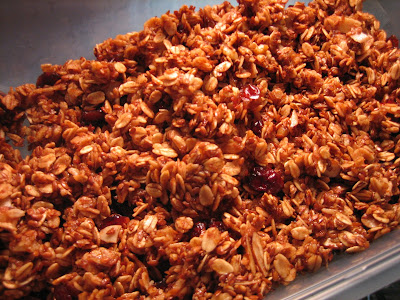
My switch to eating local, whole, & organic foods has meant that I end up making things from scratch. Before I overhauled my eating habits, I would never have considered the possibility of making granola from scratch, but here I am with a giant container of this awaiting me for breakfast:


Honestly, this is far less difficult that in would appear. Basically you just melt some sugar in orange juice and honey on the stove, stir in some oats, almonds, walnuts, flax seed, vanilla, and oil. Then put it on a cookie sheet in the oven. When finished, stir in some cranberries.

Check out the recipe for Power Granola pictured above. I promise you, it's scrumptious. I made a double batch myself. The result wasn't as crunchy as most normal granola (in a good way), which I contributed to using only one cookie tray (resulting in a doubly thick layer while baking).

Give this a try for yourself, and post the results below.

How to be Treated like a VIP at Restaurants

Monday, October 20, 2008

These 9 awesome tips come courtesy of Tim Ferriss, author of the fantastic 4 Hour Workweek. If you read The Reluctant Eater, and have similar food habits, then you probably won't be eating out all that often. So when you find a place you love, why not make your presence known?


My favorite tip:
Ask the waiter to ask the chef two questions: First, What does everyone order, and Second, what does almost no one order but the chef thinks everyone should. Then order them both.
You'll probably end up with the two best dishes on the menu, and make a memorable impression on the chef! Read the rest of Tim's tips.

Friday Interview: Sue Campbell

Friday, October 17, 2008

Today, The Reluctant Eater talks with Sue Campbell. Sue is a freelance book designer; a baby boomer, wife, mom, grandma, and struggling writer—never published—but working up the nerve. She has been a domestic diva, a goat-milking, cheesemaking, chicken tending, vegetable gardener, and organic food maven before she even knew what that was. She's an avowed suburbanite now, a Californian by birth and a Coloradoan by choice. She has a new blog called Sue Campbell Writes http://suecampbell.wordpress.com/ where she writes about books, design, publishing, and writing.


TRE: What is your current relationship with food?

SC: Ha Ha, well as you can tell...we're not strangers! I love to cook and also eat. One of life's great pleasures is discovering new tastes and new foods. Today we are so lucky to live where we do and to have the wealth of multi-culturalism here and with that comes great food. 


TRE: Which do you prefer, cooking for yourself, or others?

SC: Well when I cook for myself, it's really for my husband and me. He's open to trying new things and he has learned to eat mostly vegetarian with me. It may be old fashioned, but I really love cooking a nice meal for him as an act of love. (I do most of the cooking, though he's a pretty good cook, being a cajun.) Entertaining a crowd is more stressful, but I enjoy that challenge too. I'm hosting Thanksgiving this year, and since I pretty sure the family won't go for "tofurkey" I'll be doing the traditional bird—hopefully with a twist or two.


TRE: Thanksgiving seems to come up often in conversations with vegetarians, I think because it is a cultural tradition built around eating meat. Have you ever felt like being a vegetarian is an issue of contention with your husband or family?

Not really. I am not a strict veggie person. I eat fish a couple of times a month and very occasionally, chicken. I must confess that when on vacation I succumbed with gusto to consuming an In and Out burger in California. But only once, and it's been almost a year—in fact I made the decision right after Thanksgiving last year. I thought I would miss meat more than I do, which is hardly ever. My husband doesn't mind that much, in fact less than I bet he thought he would. It's amazing what a large variety of good tasting other foods can do in satisfying you. We did have some red meat still in the freezer over the year and I cooked it for him sometimes, certainly don't mind when others want that around me. 

The family doesn't hassle me about it either. I tell them to make whatever they would normally and I eat the parts of the meal that I want. If I were a strict vegan I imagine that would be harder. There are two other vegetarians that come to family gatherings so I have company.


TRE: Have you had pretty consistent food habits, or have there been changes throughout your life?

SC: One thing that has been consistent is that I do love vegetables. My grandparents were tenant farmers back in the "old" Great Depression. They continued to garden throughout their lives and they developed in all of us a love a fresh bounty from the garden. Nearly all of the family has gardened at one time or another. During the 1970s there was a "back to the land" movement leftover from the hippy era. I was part of that. 

My first husband and I had five acres stocked with chickens, ducks, and goats, plus a huge garden, about 50 by 100 feet. We grew most of what we ate, bought grain from a local farmer and made bread. We milked the goats and I made cheeses. We canned, and froze veggies. I even made my own baby food! There is a great sense of accomplishment in putting a complete dinner on the table made entirely of what you produced at home. We also ate our animals too, which meant killing and processing our meat. 

It wasn't that experience by the way that prompted me to become a vegetarian, butchering I mean. I'd been seeing it done since I was a child and it didn't bother me that much. It always hurt a little to have to kill a creature, but farmers grow philosophical about it. I think you have much more appreciation for the animals you eat if you make the connection between their deaths and your life. We had the solace of knowing that our critters were well cared for and happy for their time on earth and that they didn't suffer in their deaths. I don't think you can really say that about the meat industry as a whole.

Let me tell you though, that lifestyle is a LOT OF WORK! That's probably why even though I ate a lot of calories I was in good shape, because I was on the move all the time. And I was younger. So yes there have been changes too. As a young person I think you can usually eat more, and less healthy and not suffer too much, as long as you also eat good foods too. Especially if you're an athlete. I was a skater as a teen, long hours everyday. I ate like a linebacker! And it didn't show, then. But give that up, get married, have babies and hello hips. 

Your body and your metabolism changes over the years, and maybe especially for women. I am post-menopausal now and prior to about age 35 I never had to worry about my weight. After that I only need to walk by food and it's my pal for life.  I changed my habits partly because of my weight gain. Now my body has adjusted to the new food and it's hard to lose any weight on my current diet. So it's a struggle always.


TRE: People often assume that "diet food" and "trying to lose weight" go hand in hand, but food advertised to people trying to lose weight often is only "healthy" if you strictly look at the numbers (calories, fat grams, etc). It's no secret that many people are beginning to doubt this sort of "food science". How do you balance healthy eating with a desire to lose weight without going crazy with 100 calorie packs?

SC: I admit to trying different fad diets in the past. I know better now. Or, I think I do. Diets don't work. Or they work, but as soon as you stop you gain it all back because your body is efficient at saving energy (fat) as a survival mechanism. Diet foods are often just phony food with the calories and the nutrition stripped out. If you are used to eating larger portions and suddenly you get those 100 calorie packs of Oreos you're not going to be satisfied with the tiny bits you get, so you eat more (maybe not of the Oreos but anything else). Because you're not satisfied, you wind up either being very hungry or eating more. 

The problem with "diet foods" that are made specifically for dieters is that they are often not satisfying, not tasty, and not nutritious. Are you better off being good (and unhappy) not eating any fats or sweets, or other stuff you love? Or eating the right fats, the right sweets, and things you love in moderation?  If you eat larger amounts of low cal, but high bulk food like salads and other veggies, and fruit, plus a healthy fat like olive oil (in moderation) you're more likely to be happy with a small piece of chocolate for instance than say, a quart of Ben and Jerry's because you've been denying yourself yummy stuff that your body craves. Also listen to your body! Push away from the table before you start feeling like an expanding balloon.

I guess that's a long winded way of saying that I don't really eat "diet foods" anymore with the exception of diet cola and only when I am out just because I like it. I've got a pretty good idea of what is healthy food and what isn't. I can recommend a good book on diet and nutrition, You On A Diet by Drs. Oz and Roizen. While it IS a diet book, it is really a very good primer on how your body and metabolism works. The diet is more of a life change and they teach you about healthy food.

Plus you really have to exercise! 


TRE: What would you say to someone who told you that food isn't an important part of their life?

SC: Really? You are what you eat, I guess.


TRE: Despite your healthy eating habits, are there any aspects of your relationship with food (or what you eat) that you'd like to improve?

SC: Well, sometimes I wish I didn't like it so much! Portion control is the hard one. When you find out what a portion really is? A half-cup of something isn't very much!! Also, I'd learn to drink more water. I often forget.


TRE: Thank you so much for talking with us Sue. Do you have any last words of advice or wisdom for our readers?

SC: Don't be afraid to try new foods. Fresh is always better. And, food is one of life's pleasures enjoy!

 
The Reluctant Eater - Design by Templates para novo blogger || Strawberry image courtesy of Darren Hester