A Whirlwind Tour Through 8 Decades of Food Advice

Friday, October 31, 2008

Why You Shouldn't Entrust Your Eating Habits to the Media, the Government, or Food Science


Alongside 11 other fantastic presenters, The Reluctant Eater spoke at Ignite Boulder on Wednesday night. Ignite is a worldwide movement of people getting together to present and share ideas but with a twist: 20 slides, each advances automatically after 15 seconds.

My first public speaking gig in 11 years went off without a hitch, except, as you'll see, due to a technical glitch not all of the slides advance after 15 seconds. I spent so much time cutting down my speech that I wasn't prepared to have extra time, and there is a little bit of dead air! Enjoy - A Whirlwind Tour Through 8 Decades of Food Advice: Why You Shouldn't Entrust Your Eating Habits to the Media, the Government, or Food Science.


The other Ignite Boulder presentations can be found here. If you watch just one other, I'd recommend Michael Tseng, who talks about "The Perception of Possibility".

Friday Food Interview: Meredith Niles

Today, The Reluctant Eater is honored to talk with Meredith Niles (who just returned from a conference regarding green farming in Mozambique!). She is the Coordinator of the Cool Foods Campaign, a non-profit organization which challenges harmful food production technologies and promotes organic and other sustainable alternatives. Meredith writes extensively about agriculture, food, and climate change in a weekly guest column for Grist Environmental News and has contributed to National Public Radio, Environmental News Network and Political Affairs, among other outlets. Previously she worked for the U.S. State Department in International HIV/AIDS assistance and taught outdoor and environmental education.


TRE: Hi Meredith, what is your current relationship with food?

MN: I’d say my current relationship with food can be equated to that of a slightly overachieving mother.  Nurturing and comforting overall, but perhaps a bit critical and always pushing for improvement, in hopes to achieve the best result. 


TRE: What makes you "always pushing for improvement"?

MN: Because our food system has many opportunities for improvement and all people have the right to fair and real food.  Our current food system is rife with externalities that are imbedded within our environment, our health and nutrition and social inequalities.  I am hoping to educate people about some of these issues and decrease or eliminate many of the problems.


TRE: What are some of the biggest problems right now?

MN: Our food system is failing in many respects often driven by subsidies and corporate control.  But overwhelmingly, as our food has been de-localized it has resulted in fewer people knowing or understanding where their food comes from, increased environmental pollution, and a real challenge for food safety regulation.

In the United States one of our greatest failures has been our agricultural subsidy program, initially designed to help small farmers.  Today, we subsidize the production of major conventional crops, many genetically modified, including corn and soy that are among the most damaging for both the environment and our health.  They are the biggest consumers of synthetic fertilizers and pesticides and the crops most often fed to livestock or turned into by-products for heavily processed packaged foods.  So rather than giving support to small scale family farmers producing real whole fruits, vegetables, and pastured animal products, we are giving money for the vast production of corporate industrial agriculture.  It is this very type of production that contributes approximately 20-25% of all greenhouse gas emissions.


TRE: Let's say that the movement against corporate industrial agriculture explodes, and all of the sudden millions of people won't buy their products. Where will all these people get their food from? Do we have enough small farms to be able to support an increasing demand?

One of the biggest myths in our food system is that we don’t have enough food to go around, and thus have to produce more.  In fact, in the United States there are more than 3,500 calories available for each person.  Globally, the figure is above 2,700 calories- more than the average person needs each day.  So first, I think we need to understand that we are already producing a lot of food.  In fact, it’s estimated that almost 15% of our waste is from food- so we have a lot of resources that we aren’t even using.

In reality, I don’t think that millions of people are going to wake up one day and vow off corporate food, but rather, I think that we will see a continuation of what is already happening- millions of people throughout the United States and the world who are choosing a new way of eating.  Farm to school programs, urban gardens, CSAs and farmers markets are all a testament to the rise of a movement that is taking over a huge part of America.  At the same time, we are seeing a growth in small farms again in the United States as well as a very strong interest from young people to get into farming.  Women farmers are increasing significantly as are young farmers.  And I also think its important to not forget the ability of small home gardens to provide a large portion of our food.  

One of the greatest examples of this success can be found in Cuba.  After the embargoes, Cuba was not able to purchase fertilizers and import a lot of food.  As a result, and quite quickly, they transformed their agricultural system into a highly efficient, organic system.  Cuba became food sovereign and was able to utilize urban centers and people’s own backyards to increase its food supply.


TRE: Actually, when I read The Omnivore's Dilemma, a part of me wanted to become a farmer - something I had never considered before. What are some of the biggest challenges in getting people to pay attention to what they eat?

MN: Well I think the reality of many people’s lifestyles often prevents them from thinking much about where their food comes from, or what some of the issues may be associated with their food.  A lot of our foods are designed for convenience now, and in this processing step, are less recognizable as food.  All of the packaging and processing and additives that we are adding to “fast food” or “convenience food” are not only questionable for our health but also for the health of the earth.  But, I certainly understand that people feel challenged to try to prepare meals or eat healthy when they are very busy.  I struggle with this myself sometimes.

Sometimes it is also hard to encourage people to change their eating habits based on environmental issues.  Many people struggle just to put food on the table and in our increasing economic woes, this will only become more true.  But, in reality, many of the things that are better for the environment are actually better for people’s wallets as well- like buying in bulk or buying unpackaged foods.

One of the places that people always seem to pay attention to their food though is when it comes to the health and safety of the foods they are eating.  No one wants to eat anything that has been tainted with harmful chemicals or pathogens.  The salmonella scare of the summer was certainly a testament to the way that people will change their purchasing habits if they believe that something is unhealthy.  But, perhaps people do not realize that the types of foods which are healthiest for us- animals raised in humane conditions, organic produce and local foods are also those which are best for the environment.


TRE: It's always inspiring to see people turn their passion for food into a career. Tell us about what you do for work.

MN: I work at the Center for Food Safety, a non profit organization that works to protect the environment and our health by promoting sustainable agriculture and working to change industrial agriculture.  We work on many different issues including GMOs, the organic standards, irradiation, aquaculture, climate change, and chemicals/hormones in food.  A lot of our work is focused on policy, legislation and education and the organization has more than 67,000 supporters.

I have the privilege of running a campaign that we just started this year called the Cool Foods Campaign.  It’s a public advocacy education campaign designed to teach people about the impact that their food and our food system has on global warming and to help people make and find foods that are better for the earth.  We are advocating for organic, local, whole and unprocessed foods as well as decreased consumption of conventional meat and dairy products.  The campaign comes at a very crucial moment, since it is estimated that about 25% of our greenhouse gas emissions are from the food system.  Considering that everyone eats, we have the opportunity to help fight global warming every single day just by changing a few things in our diet.  I feel very lucky to have the opportunity to work on such an exciting campaign and to be able to work on something I am so passionate about- I think its quite rare.


TRE: How did you end up working at the Center for Food Safety?

MN: Actually I think that my job here has been more than a dozen years in the making.  My interest in food issues and the environment began when I was a teenager and decided to give up meat for environmental reasons.  I was always into outdoor activities and the environment as well as cooking and food.  But, it wasn’t until I was in my last year of college and took a course called “Food Politics” that I realized that my environmental and food passions could come together.  I worked as an outdoor and environmental education teach for awhile and also traveled and lived abroad, spending some time on farms in New Zealand.  When I was ready to move back to Washington, CFS just seemed like the perfect place for me.


TRE: Okay, this is probably an impossible question, but I must ask it. How do you measure the success of the Cool Foods Campaign? And a problem I deal with myself is that it's so much easier to reach the people who are already educated about food. How do you go about reaching those who aren't?

MN: This is, of course, a crucial question and a very important one.  We struggled with this question as we were developing the program which is why we came up with the Cool Foods Pledge- a non binding pledge that gives people, businesses, schools and other organizations the opportunity to commit to changing the way they eat.  The pledge has 6 statements and it has been helpful for us to sign on a variety of people and organizations.  This is one tangible way to see how we are reaching people, but we also utilize mass media to try to reach broader audiences.  

It is always challenging trying not to “preach to the converted”.  One of the ways that we have been most successful with this has been some of the media that we have been able to work with.  While it may seem common place to discuss food and environment issues in say, Environment Magazine, we have aimed to go further.  The Campaign has been featured in much more mainstream publications including Oprah Magazine, Food and Wine, Martha Stewart Radio and Today’s Dietician.  I think that it goes to show that the average person really does care about these issues and they are eager to read about what they can do.


TRE: Thank you so much for your time Meredith. Any last words of wisdom or advice?

MN: Yes- I just want to say that we should never underestimate the power of just one person and their food choices.  You know, I tell people now that eating is a political act, which may sound strange but truly it is.  When we purchase our food we are participating in a system and voting to show the type of food system that we want.  So as we think about our upcoming election certainly it’s important to vote, but I hope people also remember that we make many political decisions everyday, including with our food choices.

I’d also encourage everyone to check out the Center for Food Safety at www.centerforfoodsafety.org and also the Cool Foods Campaign at www.coolfoodscampaign.org and to sign our Cool Foods pledge!

Thanks for having me Ryan- it was a pleasure to contribute to The Reluctant Eater.

Naturally Boulder Days: PitchSlam Recap

If you couldn't make it to the PitchSlam at Naturally Boulder Days, fear not! I furiously tried to write down as much as I could, and below is my summary. It all happened so quickly, an it is entirely possible that I misspelled names of people and companies. Let me know if any corrections are needed. Also, please note that for most products, I wasn't able to jot down "organic" "local" "gluten free" "chemical free" etc...but for the most part it's safe to assume that these products are all made responsibly.

Each presenter got 60 seconds to describe their company to the panel of four judges. After the pitch, the judges gave their thoughts and advice for about a minute, and then gave either a thumbs up, neutral, or thumbs down rating. Pitches listed in order of appearance. Enjoy!

Product: Cookie dough
Catch phrase: "When you buy 3, we plant a tree"
Moderators comments: "Looking at his package, what would you tell him?" (crowd cannot control our laughter)
Judges advice: package needs to be able to identify the brand from 15 feet away
Final Score: 2 up, 2 neutral

Will's Organic - Tom Kellogg

Product: herb garlic dressing mix. Dry mix, just add olive oil, vinegar, water. 
Judges advice: it's hard to get your product into supermarkets with only 1 product...develop a few more dressings, and you'll get a better response
Final Score: 3 down, 1 neutral

Product: sunscreen soap "sunscreen simplified", nothing else like it, spf 10 - $7.99
Judges advice: potential perception issue...people think soap takes things off, but this leaves sunscreen on (pitcher reminds us that most soaps actually leave a residue)
Final Score: 2 up, 2 neutral

Oogave - Stephen Anson

Product: soda, no HFCS, sweetened with agave nectar
Notes: Natural soda market frowing, 35% in 2008. (Side note: Stephen could have a good career as that guy who does the promo voiceovers for all hollywood movies)
His quotes: 5280 magazine said he could be the "the next Izze",  "I've made every rookie mistake in the book"
Judges advice: "you'll fit in perfectly, you're pushy". Issue with using agave as a sweetener, people aren't used to that in a soda. It is unique, distribution is tough. Brand has legs, and could go other places.
Final Score: 4 up

Goodebar - Chuck & Tori Roosevelt

Product: "power twinkie" or "snack cake", organic, gluten free, egg free, wheat free,
moist, unlike other bars
Judges Advice: 95% organic....go all the way? You get built in marketing with a gluten free product, new packaging needed. Be worried about competition down the road. Bars are REALLY competitive. Maybe package like a twinkie to differentiate yourself from being just another bar?
Final Score: 1 up, 2 down, 1 neutral

Overseas Connection - Steven Karowe

Product: fair trade african market basket
Judges advice: love it, make sure product you are selling is what people want (I'm not going shopping with that bag...not right size). Love product, love story - think about channels of distribution...grocery stores might not have space, and it's $29.99...more than people often spend there
Final Score: 2 up, 2 neutral

Boulder Soupworks - Joseph Carroll

Product: Organic, fresh, gluten free soup sold in clear, see-through reusable containers to be sold in supermarkets.
Quote: "Bring back the truth in soup"
Judges advice: Like the idea and look, and you'll have to put in in the prepared food case or dairy case (which is most expensive), be in the food service area instead - airports, bagel shops. Product is "on trend" but huge distribution challenges.
Final Score: 3 up, 1 neutral

Anilla - Hank Lourie

Product: over 100 natural, personal care products, anti aging, acne, etc
Quote: "merging health care & beauty care"
Judges advice: how do you get your message out? Sounds like you are selling a category, not a brand
Final Score: 1 down, 3 neutrals

Product: cocoa with lots of fancy ingredients, even mushrooms! $10.99 for 12 oz.
Quote: "we put the mojo back in the cocoa"
Notes: 2 million hits per month on their website?!?
Judges advice: narrow down the message, love the packaging (it's rice paper)
Final Score: 3 up, 1 neutral

Product: the "un-tv dinner", just grab it and a few items from produce (I think?), take it home, and encourage your children to help and be educated in the process.
Judges advice: Love it, significant need for this, can't quite envision the product. Loved the story, what is product? It will work if you're willing to stick with it.
Final Score: 4 up

Hope Foods - Kristen Carmen

Product: gluten free pizza and pasta in the frozen foods section made by celiac chefs.
Judges advice: Name might not be right...I want delicious, not "hope" (name represents giving hope to celiacs). I need more information, what are products (she almost ran out of time before getting to the product descriptions).
Final Score: 2 up, 2 neutral

Nusa Yogurt

Product: local, all natural, hand crafted, gourmet australian yogurt in clear packaging
Judges Advice: concept is great if it can emulate rise of greek style yogurt, if you can make people buy it, it can work.
Final Score: 3 up, 1 down

Product: delivery service of prepared organic foods, "heat, eat and enjoy". She does a 15 minute consultation with you in the beginning, and from that point on she makes the meals for you, without having to choose or make specific orders. Serving boulder & metro denver
Judges advice: It's great, assuming the price point works. Healthy convenience, logistically it's daunting to scale this service, to make this work will be really hard, but what you're doing is right
Final Score: 1 up, 1 down, 2 neutral

Simply Boulder culinary sauces - Seth Mandelsohn

Product: agave sweetened cooking sauces
My notes: he sells these at the Boulder Farmers Market, and they are awesome.
Judges advice: healthy convenience. Great "tweener" category.
Final Score: 2 up, 2 neutral

Crystal River Organics - Doug

Product: nude food bars, mostly raw, gluten, soy free, nutrient dense, twice size of larabar or clif bar. They have been used for meal replacement in a weight loss program
Judges advice: bar category is tough, have you done trademark work? "I don't understand product". Moderator questions his claim that there aren't already existing savory nutrition bars?
Final Score: 2 up, 2 neutral

100 Mile Burger - Ira Leavetag

Product: fast food restaurants (burgers, hot dogs, fries, etc) will all local ingredients
Judges advice: love the local idea, but it is a retail concept, but it will fail or succeed on location and execution. Love the idea, it's all about execution, price point, taste and service. Work on the name! (100 mile burger)
Final score: 3 up, 1 neutral

Laisha - Sharon

Product: some sort of lotion, cream to support good breast health.
Quote: for "moist perkier breasts"??!? (no, I did not make that up)
Judges Advice: very interesting, good target for the internet? (discrete purchases)
Final score: 2 up, 2 neutral

Adava Foods - Julia

Product: gluten free snacks and baking mixes
Judges advice: growing sector, lots of demand, about whether you have a good product, brand building. Don't sell the category, sell the brand.
Final Score: 2 up, 2 neutral

NA Plus Ultra Foods - Nelson

Product: heirloom, artisan salts
My notes: Nelson never even said what his product was till after the pitch was over!
Judges advice: gap in that people don't understand nuances between regional salts, consumer education problem
Final Score: 1 up, 2 down, 1 neutral

Lila Films Inc - Deborah Fryer

Product: A documentary on Parkinsons, that it is often caused by environmental pollutants.
Judges advice: Great idea, connect products, information and education, get financing through partnerships of likeminded people
Final Score: 4 up

Product: none technically, it's an online shop that sells natural products to a national and international audience. Pet care, household, baby care, nutrition, etc... "just in time" inventory
Judges advice: buy stuff over the internet is a proven market, but can you target the whole world as your market?
Final Score: 1 down, 3 neutral

Gourmet PB&J - Steve

Product: the name says it all, a gourmet peanut butter and jelly sandwich shop with total ingredient transparency
Judges advice: "so wacky I kinda like it, doesn't make sense, but somehow it does, I like it but I'm not sure why"
Final Score: 4 up

Spice - Justin


Product: organic roasted nuts, selling directly to coffee shops as a point of purchase snack
Judges advice: taste great, like the name, design...you need a good package and a good price point, you need it in airports and Starbucks, etc
Final Score: 4 up

Bali Malas - Karen

Product: necklace prayer beads hand made in Bali
Slogan: "wear peace"
Note: nametags for the conference were attached to these necklaces, so most attendees wore them for the entire day
Judges advice: like product, story & vibe
Final Score: 4 up

Dog Popcorn

Product: natural popcorn in malls and high traffic areas like stadiums & arenas. Product produced locally everywhere.
Judges advice: like the product, people want simplicity...
Final Score: 3 up, 1 neutral

And the winner is:


Stay tuned for more in depth analysis.

Renegade Lunch Lady Ann Cooper Promotes Lunchroom Revolution

Thursday, October 30, 2008

This morning's 8 am presentation at Naturally Boulder Days was led by Chef Ann Cooper (her website: Lunch Lessons), who, despite her busy schedule as a chef, director of nutritional services, and consultant was able to fit in a morning full of compelling statistics, inspirational stories of improving school lunches, and a short question and answer session.


Fresh from completing a feasibility study for the Boulder School District (she primarily works in New York, and Berkley, CA), she did a great job of motivating and educating about the dire need to completely overhaul the food service in our nations schools, as well as the implicit eating habits taught to our children (well, not mine...I don't have any).

The stats hit me hardest. Here is a sampling:
  • Phillip Morris receives 10 cents of every dollar spent in grocery stores, yet farmers receive only 9 cents.
  • As much as 70% of the antibiotics consumed in this country are ingested in the meat we eat.
  • Less than 200 years ago, 95% of Americans farmed. Now less than 2% do.
  • We have 2.1 million prisoners, and 1.9 million farmers.
  • For every $1 of advertising for healthy food products, $500 is spent on junk food

The most memorable quote:
Chocolate milk is soda in drag!
Missed the talk? You can watch a similar (but abbreviated) talk she gave in December 2007, courtesy of TED. (Either she was a little frantic given the 20 minute time constraint, or she's been successfully coaches since then, but this morning's presentation was less frantic and more sincere).


"Emerging trends" breakout session at Naturally Boulder Days

This post brought to you by me, The Reluctant Eater, coming from inside the Julian Hotel & Spa in downtown Boulder, host of Naturally Boulder Days 2008. The first of two breakout sessions has just concluded. Although I begrudgingly passed up both The Climate for Innovation - What is it about Boulder? and The Perfect Consumer Storm - What do we know about the market today? I learned a great deal in Cutting Edge Trends - What's hot and why? Did we see it coming?


Moderated by Doug Radi of Rudi's Organic Bakery, the "panel" (each speaker essentially spoke for 20 minutes, followed by questioning all three for 15 minutes) was made up of:

Blake spoke mostly about marketing and branding, but I would rather call out the part that is most relevant to this blog. Trends. He briefly mentioned a few hot subjects including:
  • Locavore
  • Sustainability
  • Carbon Foodprint
  • Food Labeling

Steve spoke almost exclusively about his company Eco-Products, which was disappointing, given the topic of this breakout session. The trends he mentioned were all product related, so I'll skip that.

Finally Etai stepped up to the mic, and actually talked about trends! The recent trends that lead to their current success were:
  • A Local food economy
  • All Natural
  • Healthy
  • Artisan
  • Fresh
  • A Progressive work environment
As for emerging trends, he mentioned both granola (which is growing 40% year over year), and gluten free (which is currently a $5 billion dollar market with no clear leader).

Now, if you'll excuse me, I have some tasty samples to eat (currently munching on jerky from Colorado's Best Beef)!

Overheard during Naturally Boulder Days

  • More people are sick during the holidays because of stress and poor eating habits
  • There has been recent media coverage of growing meat in a lab
  • According to one rancher, cows don't have a problem digesting grain. ?!?
Most referenced local supermarket: Sunflower. 

Naturally Boulder Days: Biodiesel Bus Tour Overview

Wednesday, October 29, 2008

I just got back from the opening event of Naturally Boulder Days 2008, the Biodiesel Bus Tour. For now, I will give you a quick overview of our three stops, but look forward to more detailed posts in the future.

Stop #1: Bud Peterson's Xcel Smart Grid Home

While admittedly, this has nothing to do with food, I can say that I have seen the future of energy consumption. Basically, everything in the house is hooked up in such a way that power consumption can be monitored through a simple web interface. Want to know what items are consuming the most power? Want to control your thermostat from anywhere in the world? How about sell power back to the grid? You can do all of those things, and more. Pretty neat.

Parked out front? A gas/electric SUV that gets ~100 mpg in the city, 54 overall. Crazy right? The gas motor doesn't kick in until ~30 mph. Average cost is 4 cents per mile, vs. 25 cents for it's gasoline powered equivalent.

Stop #2: Udi's Bakery

Udi's is the premier artisan breadmaker in the Boulder / Denver area, producing around ~6000 loaves of bread per day, all custom ordered. Primarily, these are sold to farmers markets and local restaurants (none of their bread is shipped outside the Boulder / Denver area).

We were allowed to don lab coats and hair nets to tour the inside. The whole concept of starters is new to me, but apparently it's the base that will be mixed with the dough. The acidity, texture, and crust are all affected by the starter, which is left out to ferment and develop into a leavener. Below is a video of me touching a few of the "starters" they had laid out.


No, these will not be made into bread - just samples for us to play with! On the way out, we all received loaves of bread (not to mention the FANTASTIC box lunches, from Udi's catering biz, we hate beforehand)! I wrote down a ton of other interesting facts about the company, which I will turn into a more detailed post in a few days. 

Stop #3: Seth Ellis Chocolatier

Let me just come right out and say it - high end chocolates are not my bag baby (I'm a cookie/brownie guy). However, the Seth Ellis Raspberry Truffle? WOW. I'm a believer.

By the way, their products are all organic and they do lots of private label orders (you know, in case you want to impress hundreds of guests with your own custom chocolate bars).

Stay tuned - more to come from Naturally Boulder Days 2008!

How to Give up Dessert: Feeling Satisfied Without Sweets after Meals

Tuesday, October 28, 2008

Prepare for the shortest how-to advice ever. How can you stop that feeling of needing sweets after a meal to feel fully satisfied? Follow these simple steps:

  1. Eat Real Food
There isn't any other secret. No joke.

Before I started eating local, organic, real food, I never felt satisfied after a meal without dessert. In fact, the guy behind the counter at Dunkin Donuts began to recognize me as "that guy who comes in around 7 and orders a Glazed Stick (or Cruller as it's called in some regions) with no bag". I'd eat it on the way home, and feel satisfied.

Since changing what I eat (no more processed, boxed foods), I've slowly (and unintentionally) weaned myself from this need. I say unintentionally because frankly, dessert is awesome. Who wants to give that up? Unless you have serious weight issues, you shouldn't have to.


But imagine not needing it anymore? I now eat dessert as a special treat, not as a necessary end to every meal.

How did this happen? Well, processed foods are filled with sugar, and sugar is essentially empty calories. Not only that, but sugar is addictive. It isn't surprising that many meals are not satisfying, and leave you craving more sugar. Have you seen Super Size Me? Several days into a McDonalds only diet, Morgan Spurlock finds himself obsessively craving the food. Even though it appears that he is eating normal food, by the end of the month, he averaged over a pound of sugar per day!

Conclusion? Eat dessert once in a while because it's a tasty, decadent treat - not because you need it.

It's liberating - trust me.

Big News this week for The Reluctant Eater

Monday, October 27, 2008

Several great things are happening this week for The Reluctant Eater. Here is a quick summary, but read on for more details.

  • I will be reporting from Naturally Boulder Days this Wednesday & Thursday
  • I am giving a presentation on food headlines since 1935 at Ignite Boulder this Wednesday
  • The Reluctant Eater has become a Featured Publisher for FoodBuzz!

The Reluctant Eater Reporting from Naturally Boulder Days

Naturally Boulder Days, held October 29th & 30th here in Boulder, CO, is the event for local food & natural products entrepreneurs. There are information sessions, lunches with a mentor, tours of local companies, new ideas & product pitches, and plenty of networking opportunities.


I will update this site throughout the event with any kind of information you might find useful. Keep in mind, although most of the companies mentioned will be local to the Boulder area, there will be plenty of the content I post will appeal to a wider audience, for example the break out session covering emerging trends in the industry. Check back here often on Wednesday, Thursday, & Friday.

The Reluctant Eater Presenting at Ignite Boulder

Ignite is a worldwide movement of people gathering together to share information and ideas on a wide variety of topics. However, it's not that straightforward. Each presenter gets only 20 slides, which automatically advance every 15 seconds. It's harder than you think!

Presentation ideas need to be submitted and approved by a panel, and mine was accepted this weekend! The topic, based on these two posts, is titled:
A Whirlwind Tour Through Eight Decades of Food Advice: Why You Shouldn't Entrust Your Eating Habits to the Media, Government, or Food Science
This will be a great event, so if you live in the area, come out and show your support, learn a few things, and please introduce yourself! Tickets are free, but as of this writing there are only 41 left. Click here to get yours. If you miss it, next week I will post the video of my presentation, along with my notes and the powerpoint slides.

The Reluctant Eater: A Featured Foodbuzz Publisher

You may notice the Featured Publisher badge down in the lower right hand corner of each page. There may be a few more layout changes to accommodate another Foodbuzz banner. Fear not intrepid reader, nothing else will change (other than some increased traffic to this site)! Foodbuzz is a great site that collects and ranks the best food related blogs and websites. Many of their current publishers focus on recipes, so I am honored to be one of the few that doesn't!

If you are interested in checking out their site, please consider voting for me. Nothing says "this site has great content" better than a vote, and it will lead to increased visibility and readership. Thanks!
Lots of exciting things are happening this week. Be sure to check back often!

Friday Food Interview: Andrew Schwerin

Friday, October 24, 2008

Today the Reluctant Eater talks with Andrew Schwerin. His interview below provides great insight into his long resume of food "life experience". He particularly loves Glacier Ice Cream's Key Lime Pie ice cream (not the sorbet, mind you) and can't understand why it isn't more available. To keep his mind limber, he plays ultimate, lifts weights, rafts, climbs and snowboards and dabbles in pottery and silversmithing. He is currently in his third year of graduate studies at CU working on a high-efficiency solar cell.


TRE: Hi Andrew, thanks for talking with us. What is your current relationship with food?

AS: That's a pretty broad question, so I'll just pick one inroad and start there. I worked on a vegetable farm for two seasons after college. Actually, to start back even farther, I worked on my college garden. I went to Dickinson college, and I graduated in 2004, so at that time a movement toward sustainability, good food, all that stuff was starting to grow in the college. It wasn't just students; it was professors and administration too.

Now, it's huge there; it's one of the things the college prides itself on most. But to get back to the point, back then, we had a garden. It was about 1to 1 1/2 acres at that point. To put it in perspective, this is about the size of your average lot of land in boulder, house and all. So we had about 30 outdoor plots, 3 feet by 8 feet, plus 3 greenhouses. One of my favorite things was getting turned on to Asian greens in the early spring and late fall. Bok choi, tat soi, hun tsai tai, autumn poem...all good stuff. In fact, there I really got into salad altogether. Salad wasn't just this afterthought or this stuff you at because you felt like you "should," when you have those really fresh greens, like, you can taste the life right in them, it really explodes. I guess if I could pick a beginning for my conscious relationship with food, it would be then and there.
 
I graduated college. I knew that a few of my friends from school had worked for Chip and Susan Planck in Virginia. They run Wheatland Vegetable Farms in Purcellville, which in the Appalachian Piedmont, about an hour from DC. I got down there that summer and worked for them for the full season, until election day, 2004. That was around their 20th or 25th year and they're still at it, although they're planning to wind down soon.
 
There were a lot of college students, recent grads and people taking a semester off working there. Chip and Susan wrote this 4 page brochure for prospective workers. The gist of it was, "We work very very hard, in the hot sun and in the rain, and in the peak season, we'll work harder then you ever imagined was possible. We've also had some great conversations, some great meals, and earned pretty well." That sums up WVF.

They weren't trying to scare anyone off, just get people ready for what they were getting into. You have to understand that, as good as this change in consciousness is, with people getting into better eating, people's notions of farming now are so romanticized. They had the occasional person showing up that would think that they were going to frolic in the meadows and play medieval ballads on the lute to goats or some bullshit (I'm not making this up), and they would inevitably have to work, and they'd cry, and quit. So Chip and Susan tried to minimize "situations" like that.
 
It was true, too. I worked some eighty hour weeks and some twenty hour days. I was also pretty happy nearly every day there. Not to sound trite, but I just really believed in what we were doing, and I had awesome friends to do it with. Without that belief, I couldn't have worked that hard. To me, we fed the city. Our stuff looked awesome at the markets and people lined up for it and paid what we asked them. That's success right there. And it never got old for me. At nearly every market, I was just blown away how our hard work really shined through in how good our food looked.

You would think that for Susan, after twenty years of this, SHE would be tired, but no. If I had a picture or a video of this spectacle it would all make sense and you'd be shocked, but use your imagination: it's 7:30 AM, Falls Church VA, and she's skipping up and down the aisles of our market stall, clapping and yelling about how good it looked.  
 
So, back to food. If it wasn't apparent from above, let me drill this in to your heads one last time: OUR SHIT LOOKED AWESOME. Rather, OUR SHIT WAS AWESOME. In fact, more than anything, our food kept us working hard. If there was one thing we learned, and only one thing, it was that there is right way and wrong way to pick vegetables. There's a window when it will be optimum quality. I wouldn't say a small window, but a window, nonetheless. I know how amazing it can be to see a giant zucchini, but I just think "seedy, tough, yuck." I've also seen these tiny zucchini in packs and I think "useless." Chip and Susan would check our pick and check for aberrantly sized vegetables, and believe me, if it was poorly picked, they caught it.
 
We were all about that optimum size before it gets seedy and the skin gets tough. That went for any vegetable. I remember I had some squash once that wasn't picked right and it was tough and seedy! I eat like a beast but I can't eat stuff that's past it's prime like that.
 
DC has an awesome market system. At the big ones like DuPont Circle, there were vegetables, orchard fruit, cheese, meat, prepared food, milk, soaps, and fish. There were a few vendors in each category too. So, we had all of these vegetables, what were we going to cook with them? We got good beef and chicken from Polyface, Joel Salatin's farm. I think every week we tried a different cut of meat. Flank steaks, rib roasts, all kinds of stuff I never would have thought of, but since he raised the whole beef, he had to sell every part of it, so he made it his business to market that stuff.

I'd been a vegetarian up to that point, but all the hard work, and all the good meat available made me switch sides. A lot of times, people take up vegetarianism against the factory farm system, but why not buy some well raised meat? (TRE: this is exactly the stance I take)
 
You could call it an experimental phase. We made tons of crazy food because we had access to it and we were creative and just curious. Once we made fish stock with fish heads from Buster, the guy at the DuPont market. Tons of good vegetables from our farm or the farm next door, fresh fish heads, good well water. Glory times. We had a neighbor shoot a deer that was eating our vegetables. You want local raised? That thing was from 50 feet away.

We butchered it; gave him one tenderloin and we kept the other. We used some of the bones for soup. Then we had a barbeque and roasted a leg all day. It still had the hoof on it. I think some vegetarian was appalled. The shock of seeing a hoof and knowing it was a real animal that was once alive...or because I was drunk and chasing her around the farm with a deer leg and hoof. If you're reading this, Samantha Kushnick, I'm sorry.
 
All that stuff left an impact on me. I consider myself a pretty good eater and a good cook. I know how to cook at a lot of different levels: I can cook a few courses for guests coming for a dinner, or I can cook for myself and make sure I eat well with relatively little hassle all week. It's like going to the gym, in that it may be a little slow to start up, but I have to do it. Sunday will roll around, and I'll be all "Alright, let's get this thing rolling" but then I'll be cooking and having a blast.

I was reading the Ween page (click on the pic there for the rest of the story/recipe) and Deaner wrote how he likes to get nice and drunk when he's cooking. It totally reminded me to lighten up Cooking is this energetic exchange. I can bang that shit out just so I can eat, but that's no fun, and that'll come through in the product. IOW, it'll be shitty. If I set aside a little time, get nice and drunk, and have some fun with it, I've got some good food for the week.


TRE: Wow, what a complete response! Going back even a little further, what was the food environment like in your house while growing up?

AS: Pretty good, actually. Both of my grandmothers were pretty solid cooks. My Bubbee made all the stuff for holidays: matzo ball soup, tzimmes, brisket, kugel. Heavy Jewish food. We had a high standard for what a "good bagel" was too. Grandma Schwerin was a cook and a gardener up until her really late years. She had an excruciatingly high standard for beans and corn. Plus we'd always have a perfect roasts. We'd stay down the shore every summer, so tons of fish, a few rounds of lobster, clams...my fishmonger just closed his business in August and I was way sad.
 
My mom cooked a lot. Dad grilled a ton. There are some recipes, I wouldn't call them family recipes since it sounds Hallmark-y, but there's still some recipes we haven't stopped using. There's this pork tenderloin with honey lime marinade that kicks ass. Only now that there's been this overall change in consciousness, they're way into shopping for better ingredients. More than I ever thought you could be. In Philly they go to the Clark Park market in West Philly.
 
We're a product of our times, and we're not totally in control of our environment, so I ate pretty well, all things considered. I know that especially In those teenage years, there must have been a pretty solid window of about 10 years of slurpees and McDonalds, which probably fucked my head up. I can't look at the stuff now. It's not a statement or anything, I just don't want to eat it.


TRE: So it sounds like even though you did have somewhat of an epiphany moment in college, there has has always been a strong emphasis on food in your life. Do you have anything to say to people who don't put much time and effort into what they eat?

AS: I'd say, "Quit eating crap!" No...I'm not dogmatic about it. But sometimes I do sit and wonder how people can get through their lives feeling like feeding themselves is a chore instead of a joy (one of my pet peeves is when waiters ask if you're still "working on that." Again, like it's a damn chore to eat their food.) So I'd say to make some space in your day or week to enjoy food. One meal...and start there. Just enjoy it.

Now, nothing good in life is going to get handed to you. Just like searching for a good job, staying in shape, or learning an instrument, it takes some work. You'll need to put a little work in to eating well. But once you build it in to a part of your lifestyle, you'll look at how you used to do things and wonder how you got by like that. 


TRE: A little birdie told me that you occasionally pick your own mushrooms. Can you tell us about that?

AS: Sure! I heard about it when I was back on the farm. There was Wachington Mycological Club, WMC. I never got to go out with them, but when I got out here, I found a club, the Colorado Mycological Society. I learned from some people there and then went out on my own. It's fun. I have this "It's just a walk in the woods, and if I find mushrooms, it's gravy" attitude. You know that expression "The hungry don't get fed?" If you go out all hungry to score, you'll be sad.
 
The season runs from about June to September. You need rain, so in Colorado, you need to go higher. There are some on the Front Range, but higher is better. Boletes are good - you get a lot of meat on each one and they're easy to identify. I like to fry them in butter, oil and garlic, and have them on some bread. Then you soak the bread in the oil and it's great. I usually bring a little stove and a pan when I go out, especially with newbies. that instant reward usually hooks them right into it. It's funny that in so many other countries, it's just your hobby and everyone does it.


TRE: Actually, that "bring a little stove" part is a great hook, maybe that's something I will try next season? I continue to be surprised how pervasive the natural food culture is here in Boulder, is that something you will look for if you ever decide to move?

AS: Not specifically...I feel like it's become part and parcel with so many other things I'm into, I wouldn't worry about moving somewhere and not eating well there. On the other side of the coin, I know there are some regions that really have a lot of regional pride in the food they produce: the Northwest and all those fish and mushrooms, the all that well raised meat in the midwest. I think it's going to be there if you look for it. So I would just be amped to check out what other regions really have.


TRE: Here in Colorado, what do you do after the farmers market has closed up for the season?

AS: I know a few farms, like Abbondanza and Jay Hill do greenhouses and do vegetables pretty late through the season. I'll do that this year. I have a chest freezer so I freeze a ton of stuff: cherries, peaches, blueberries. But I really crave fresh greens in the winter time, so I'll hit those farms up. Other than that, I just get what I can at the grocery store.


TRE: Thanks so much for sharing Andrew. Do you have any final words of wisdom or advice for our readers?

AS: I think I've got it all out, thank for the talk.

Proof: The Sweet Surprise High Fructose Corn Syrup Campaign was a Mistake

Thursday, October 23, 2008

This graph shows you why the Sweet Surprise campaign promoting High Fructose Corn Syrup effectively shot itself in the foot. The top blue line represents worldwide Google searches for the phrase "high fructose corn syrup" since 2004. The bottom blue line represents the number of times "high fructose corn syrup" appeared in Google News stories over the same period of time.

(click here for full interactive results)

Allow me to summarize:

2004 - Little to no awareness of high fructose corn syrup.
2005 - Shhh....it's still quiet.
2006 - Dum de dum de dum, whoops...a small bump in the road.
2007 - We're still in the clear...keep putting that sludge into food products.
2008 - Somehow we continue to get away with this....OH MY GOD!!!!

That, my friends, is how you design a horrible, horrible roller coaster.

The key is in the numbered flags, which represent major news stories: lawsuit settlements, scientific analysis, debunking scientific analysis, ruling against the Mexican HFCS tax, etc. Notice that across the entire four years, major news coverage regarding high fructose corn syrup did not translate into increased consumer awareness or interest (when people are interested in something, they Google it). The two lines do not seem to correlate at all.

From a news perspective, things appeared to get rough in 2007 and 2008, with many more bursts of stories covering this overlord of cheap calories. But yet, the googling trends remain flat.

What in the name of government subsidies happened in August of 2008? That's right: the Sweet Surprise Campaign launched with primetime TV commercials promoting high fructose corn syrup. I've written about it before (and you should absolutely click thru and watch them), but if Google is any guide (and it is), the Corn Refiners Association screwed up big time and brought attention to a problem that barely existed.

But don't stop now, your commercials continue to amuse and entertain the enlightened eaters in TV land. At a time like this, there is really only one thing to say:


Trading Sugar for Salt

Wednesday, October 22, 2008

This story courtesy of The Food Section via this Wall Street Journal article:

According to Consumers International, "manufacturers are likely to add salt to boost the flavor of the product, and may use salt to maintain customer appeal when sugar levels are reduced." In the study, a sampling of Kellogg's Frosties Reduced Sugar cereal was found to contain, on average, 1.5% salt, an amount that is larger than you would find in potato chips.

Moreover, the reduced sugar cereal compared unfavorably to a sample of a full-sugar kids' cereal, Kellogg's Smacks, which averaged less than 1% salt.
Let me repeat that: LARGER THAN YOU WOULD FIND IN POTATO CHIPS, a food that is generally assumed to be one of the saltiest foods on the shelves. I can't say for sure that one is necessarily better than the other, but clearly we should be aiming for food that needs neither. Right?

Make Your Own Granola

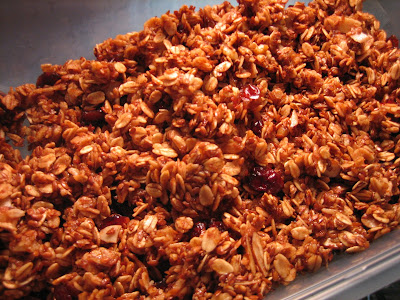
My switch to eating local, whole, & organic foods has meant that I end up making things from scratch. Before I overhauled my eating habits, I would never have considered the possibility of making granola from scratch, but here I am with a giant container of this awaiting me for breakfast:


Honestly, this is far less difficult that in would appear. Basically you just melt some sugar in orange juice and honey on the stove, stir in some oats, almonds, walnuts, flax seed, vanilla, and oil. Then put it on a cookie sheet in the oven. When finished, stir in some cranberries.

Check out the recipe for Power Granola pictured above. I promise you, it's scrumptious. I made a double batch myself. The result wasn't as crunchy as most normal granola (in a good way), which I contributed to using only one cookie tray (resulting in a doubly thick layer while baking).

Give this a try for yourself, and post the results below.

How to be Treated like a VIP at Restaurants

Monday, October 20, 2008

These 9 awesome tips come courtesy of Tim Ferriss, author of the fantastic 4 Hour Workweek. If you read The Reluctant Eater, and have similar food habits, then you probably won't be eating out all that often. So when you find a place you love, why not make your presence known?


My favorite tip:
Ask the waiter to ask the chef two questions: First, What does everyone order, and Second, what does almost no one order but the chef thinks everyone should. Then order them both.
You'll probably end up with the two best dishes on the menu, and make a memorable impression on the chef! Read the rest of Tim's tips.

Friday Interview: Sue Campbell

Friday, October 17, 2008

Today, The Reluctant Eater talks with Sue Campbell. Sue is a freelance book designer; a baby boomer, wife, mom, grandma, and struggling writer—never published—but working up the nerve. She has been a domestic diva, a goat-milking, cheesemaking, chicken tending, vegetable gardener, and organic food maven before she even knew what that was. She's an avowed suburbanite now, a Californian by birth and a Coloradoan by choice. She has a new blog called Sue Campbell Writes http://suecampbell.wordpress.com/ where she writes about books, design, publishing, and writing.


TRE: What is your current relationship with food?

SC: Ha Ha, well as you can tell...we're not strangers! I love to cook and also eat. One of life's great pleasures is discovering new tastes and new foods. Today we are so lucky to live where we do and to have the wealth of multi-culturalism here and with that comes great food. 


TRE: Which do you prefer, cooking for yourself, or others?

SC: Well when I cook for myself, it's really for my husband and me. He's open to trying new things and he has learned to eat mostly vegetarian with me. It may be old fashioned, but I really love cooking a nice meal for him as an act of love. (I do most of the cooking, though he's a pretty good cook, being a cajun.) Entertaining a crowd is more stressful, but I enjoy that challenge too. I'm hosting Thanksgiving this year, and since I pretty sure the family won't go for "tofurkey" I'll be doing the traditional bird—hopefully with a twist or two.


TRE: Thanksgiving seems to come up often in conversations with vegetarians, I think because it is a cultural tradition built around eating meat. Have you ever felt like being a vegetarian is an issue of contention with your husband or family?

Not really. I am not a strict veggie person. I eat fish a couple of times a month and very occasionally, chicken. I must confess that when on vacation I succumbed with gusto to consuming an In and Out burger in California. But only once, and it's been almost a year—in fact I made the decision right after Thanksgiving last year. I thought I would miss meat more than I do, which is hardly ever. My husband doesn't mind that much, in fact less than I bet he thought he would. It's amazing what a large variety of good tasting other foods can do in satisfying you. We did have some red meat still in the freezer over the year and I cooked it for him sometimes, certainly don't mind when others want that around me. 

The family doesn't hassle me about it either. I tell them to make whatever they would normally and I eat the parts of the meal that I want. If I were a strict vegan I imagine that would be harder. There are two other vegetarians that come to family gatherings so I have company.


TRE: Have you had pretty consistent food habits, or have there been changes throughout your life?

SC: One thing that has been consistent is that I do love vegetables. My grandparents were tenant farmers back in the "old" Great Depression. They continued to garden throughout their lives and they developed in all of us a love a fresh bounty from the garden. Nearly all of the family has gardened at one time or another. During the 1970s there was a "back to the land" movement leftover from the hippy era. I was part of that. 

My first husband and I had five acres stocked with chickens, ducks, and goats, plus a huge garden, about 50 by 100 feet. We grew most of what we ate, bought grain from a local farmer and made bread. We milked the goats and I made cheeses. We canned, and froze veggies. I even made my own baby food! There is a great sense of accomplishment in putting a complete dinner on the table made entirely of what you produced at home. We also ate our animals too, which meant killing and processing our meat. 

It wasn't that experience by the way that prompted me to become a vegetarian, butchering I mean. I'd been seeing it done since I was a child and it didn't bother me that much. It always hurt a little to have to kill a creature, but farmers grow philosophical about it. I think you have much more appreciation for the animals you eat if you make the connection between their deaths and your life. We had the solace of knowing that our critters were well cared for and happy for their time on earth and that they didn't suffer in their deaths. I don't think you can really say that about the meat industry as a whole.

Let me tell you though, that lifestyle is a LOT OF WORK! That's probably why even though I ate a lot of calories I was in good shape, because I was on the move all the time. And I was younger. So yes there have been changes too. As a young person I think you can usually eat more, and less healthy and not suffer too much, as long as you also eat good foods too. Especially if you're an athlete. I was a skater as a teen, long hours everyday. I ate like a linebacker! And it didn't show, then. But give that up, get married, have babies and hello hips. 

Your body and your metabolism changes over the years, and maybe especially for women. I am post-menopausal now and prior to about age 35 I never had to worry about my weight. After that I only need to walk by food and it's my pal for life.  I changed my habits partly because of my weight gain. Now my body has adjusted to the new food and it's hard to lose any weight on my current diet. So it's a struggle always.


TRE: People often assume that "diet food" and "trying to lose weight" go hand in hand, but food advertised to people trying to lose weight often is only "healthy" if you strictly look at the numbers (calories, fat grams, etc). It's no secret that many people are beginning to doubt this sort of "food science". How do you balance healthy eating with a desire to lose weight without going crazy with 100 calorie packs?

SC: I admit to trying different fad diets in the past. I know better now. Or, I think I do. Diets don't work. Or they work, but as soon as you stop you gain it all back because your body is efficient at saving energy (fat) as a survival mechanism. Diet foods are often just phony food with the calories and the nutrition stripped out. If you are used to eating larger portions and suddenly you get those 100 calorie packs of Oreos you're not going to be satisfied with the tiny bits you get, so you eat more (maybe not of the Oreos but anything else). Because you're not satisfied, you wind up either being very hungry or eating more. 

The problem with "diet foods" that are made specifically for dieters is that they are often not satisfying, not tasty, and not nutritious. Are you better off being good (and unhappy) not eating any fats or sweets, or other stuff you love? Or eating the right fats, the right sweets, and things you love in moderation?  If you eat larger amounts of low cal, but high bulk food like salads and other veggies, and fruit, plus a healthy fat like olive oil (in moderation) you're more likely to be happy with a small piece of chocolate for instance than say, a quart of Ben and Jerry's because you've been denying yourself yummy stuff that your body craves. Also listen to your body! Push away from the table before you start feeling like an expanding balloon.

I guess that's a long winded way of saying that I don't really eat "diet foods" anymore with the exception of diet cola and only when I am out just because I like it. I've got a pretty good idea of what is healthy food and what isn't. I can recommend a good book on diet and nutrition, You On A Diet by Drs. Oz and Roizen. While it IS a diet book, it is really a very good primer on how your body and metabolism works. The diet is more of a life change and they teach you about healthy food.

Plus you really have to exercise! 


TRE: What would you say to someone who told you that food isn't an important part of their life?

SC: Really? You are what you eat, I guess.


TRE: Despite your healthy eating habits, are there any aspects of your relationship with food (or what you eat) that you'd like to improve?

SC: Well, sometimes I wish I didn't like it so much! Portion control is the hard one. When you find out what a portion really is? A half-cup of something isn't very much!! Also, I'd learn to drink more water. I often forget.


TRE: Thank you so much for talking with us Sue. Do you have any last words of advice or wisdom for our readers?

SC: Don't be afraid to try new foods. Fresh is always better. And, food is one of life's pleasures enjoy!

"While there are alternatives to oil, there are no alternatives to food"

Thursday, October 16, 2008

The title of this post comes to us from the recent New York Times article "Farmer in Chief" by Michael Pollan. Written in the form of a letter to our would be president, it is literally bursting with eye opening statistics and proposed policy changes designed to get our nation's food culture back on track.


If you have not read one of his books (notably: In Defense of Food & The Omnivore's Dilemma), this article is a fantastic primer covering a wide range of topics. He informs us where we were:
"..modern food processing and packaging and transportation have together transformed a system that in 1940 produced 2.3 calories of food energy for every calorie of fossil-fuel energy it used into one that now takes 10 calories of fossil-fuel energy to produce a single calorie of modern supermarket food."
The health crisis this has led us to (an important issue for McCain and Obama):
"Four of the top 10 killers in America today are chronic diseases linked to diet: heart disease, stroke, Type 2 diabetes and cancer. It is no coincidence that in the years national spending on health care went from 5 percent to 16 percent of national income, spending on food has fallen by a comparable amount — from 18 percent of household income to less than 10 percent. While the surfeit of cheap calories that the U.S. food system has produced since the late 1970s may have taken food prices off the political agenda, this has come at a steep cost to public health. You cannot expect to reform the health care system, much less expand coverage, without confronting the public-health catastrophe that is the modern American diet."
How we ended up in this mess:
"Right now, the government actively discourages the farmers it subsidizes from growing healthful, fresh food: farmers receiving crop subsidies are prohibited from growing “specialty crops” — farm-bill speak for fruits and vegetables. Commodity farmers should instead be encouraged to grow as many different crops — including animals — as possible. Why? Because the greater the diversity of crops on a farm, the less the need for both fertilizers and pesticides."
And:
"In fact there is nothing inherently efficient or economical about raising vast cities of animals in confinement. Three struts, each put into place by federal policy, support the modern CAFO (Confined Animal Feeding Operation), and the most important of these — the ability to buy grain for less than it costs to grow it — has just been kicked away. The second strut is F.D.A. approval for the routine use of antibiotics in feed, without which the animals in these places could not survive their crowded, filthy and miserable existence. And the third is that the government does not require CAFOs to treat their wastes as it would require human cities of comparable size to do."
And what we need to get out of this mess, including a more complete definition of "food" to prevent, for example, people using food stamps to buy soda, and the inclusion of a second calorie count on packaged foods, detailing how many calories of fossil fuels were burned in its production.

What do I think? Normally I don't believe that many problems can be effectively resolved by government intervention, however in this case, government got us into this mess, and government will have to get us out. Not only does this entail reversing some of the bogus policies that have, for example, created a system where grain and corn are cheaper to buy than to produce, but also to lead us into a new era of food culture by example (Pollan suggests The White House: become more transparent in terms of its meal service, plant a fruit and vegetable garden on the lawn, and promote one meatless day per week).

Rising energy and fuel costs have created a shift in our awareness of our environmental impact and its consequences (resulting in more responsible driving habits), and I believe we will soon see the same thing with regards to our food choices. Prices have risen dramatically in recent years, and will skyrocket even further if certain subsidy programs are terminated. This will cause a re-evaluation of eating habits, turning more people towards growing their own food, and buying from small, local farmers (whose sustainable practices will insulate them from increased costs relative to the industrial food chain that relies almost entirely on purchased inputs).

About cost, Pollan writes:
"Yes, sun food costs more, but the reasons why it does only undercut the charge of elitism: cheap food is only cheap because of government handouts and regulatory indulgence (both of which we will end), not to mention the exploitation of workers, animals and the environment on which its putative “economies” depend. Cheap food is food dishonestly priced — it is in fact unconscionably expensive."
Finally, the interviews conducted on The Reluctant Eater definitely suggest a strong correlation between the food culture we grow up in, and healthy, sustainable food choices we make as adults.  Perhaps focusing our efforts on educating children about the dangers of continued apathy towards our food culture is a worthwhile endeavor? Imagine the impact of being educated at an elementary school with its own farm.

If you don't have the time to read the entire article, I urge you to read just the final section "III. Rebuilding America's Food Culture".

If you enjoyed this post, please email it to a friend by clicking the link below. It will only take a few seconds, and together we can educate people about this situation, if only one person at a time. Also, feel free to contribute your thoughts in the comments below!

Naturally Boulder Days: October 29th & 30th

Wednesday, October 15, 2008

For all you local Boulder readers, check out Naturally Boulder Days 2008.


This should be a fantastic event. From their website:

Naturally Boulder Days is fast becoming "the" educational, informational and inspirational event for companies both starting and expanding in the natural and organic space.
There are a ton of events packed into just two days, but I'm most looking forward to the insider bus tour of local establishments, and the 60 Second Pitch Slam, where entrepreneurs get to pitch their ideas to an expert panel.

Have no fear, The Reluctant Eater will your eyes and ears throughout the event!

Food Buzz: What the Foodies are Saying

Tuesday, October 14, 2008

I just stumbled across the site foodbuzz where people submit posts and recipes, which are then voted up or down by readers so that the cream rises to the top.


For the full experience, I used foodbuzz to help me with breakfast, and settled on Fluffy Whole Wheat Pancakes, courtesy of Whole Grain Gourmet.


Generally I prefer thin pancakes, but with whole wheat you generally end up with a thick, dense stack that is a chore to finish by the end. These however, lived up to their billing, and were suprisingly fluffy, sweet, and generally fantastic. It's true, you can basically eat them without syrup. I added a little bit of Ela Family Farms Peach Butter here and there, which ends up tasting more like apricot than peach even though the only ingredients are peaches (?). I vastly prefer (and obsess about) their Peach/Apple, Peach/Pear, or Pear/Apple.

Take a look at foodbuzz, and if you sign up, befriend thereluctanteater!

 
The Reluctant Eater - Design by Templates para novo blogger || Strawberry image courtesy of Darren Hester